Monday, October 31, 2011

Green Tomato Pickles


This week I've been picking as much of the garden produce as I can before a killing frost comes. We've had 2 light frosts but even the basil plants haven't been hurt much. Yet. After a summer of drought and heat and low tomato and pepper production, those plants have gone into high gear, trying to catch up on production.

Adam, who I have written about here many times, left us with a fabulous fall garden. Too bad he didn't get to enjoy such lushness during the summer when he was farming the garden and selling at local farmers markets. (Adam left in mid September to work on a farm in Maryland for the winter; that farm sells at the DuPont Circle farmers market the year around).

Ten pints of fish house green tomato pickles.

I've spent the day today, putting up some of the excess produce. With all the green tomatoes, I wanted to use the smaller ones for fish house green tomato pickles. They're a favorite in the catfish restaurants in the South and it's a great way to use up some of the tomatoes. Josh plans on making green tomato mincemeat, too, for pies this winter.

Tomatoes ripening in the window.

The larger green tomatoes will simply stay on the kitchen windowsill where they will slowly ripen over the next couple of months. (I've used the wrap-in-newspaper method, which is a hassle, also the put-in-the-basement method, also a hassle to check every couple of days; on the windowsill, where I see the tomatoes every day, is the easiest and simplest and works just fine. Some years we have the last of our summer's ripe tomatoes on Christmas Day).

You can use green tomatoes in any recipe that calls for ripe tomatoes, too.

Here's the recipe in case you want to use up your green tomatoes:


Catfish-House Green Tomato Pickles

2 quarts quartered green tomatoes
2 cups chopped onion
1/3 cup chopped hot peppers
1/3 cup chopped sweet red bell peppers
2 cups sugar
3 Tablespoons salt
3 cups apple cider vinegar
1 teaspoon celery seed
1/4 teaspoon yellow mustard seed

Combine ingredients in a large cooking pan and bring to a slow boil. Let simmer for about 5 minutes. Ladle into hot, sterile jars, wipe lip edge of jars, screw on hot, new jar rings and flats and lightly tighten. Place into a boiling water bath, with at least 1/2 inch of water above the jar lids. Bring to a boil and keep slowly boiling for 15 minutes (for pints). Remove and cool on a towel. Don't tinker with the lids, they will seal in a few minutes. Let cool overnight then label and store in the pantry. These are best after the flavors have matured, about 2 weeks or more.

Hot sauce with a kick, and green tomato salsa are from a single recipe. 

I also made a batch each of green tomato salsa and one of green tomato hot sauce. If you'd like the recipe for those, visit my recipes blog. Both are a combination of varieties of hot peppers and it's a tasty hot sauce with a real kick.

Saturday, October 8, 2011

Planning a Different Kind of Garden Next Year

Lettuce is a crop that thrives in cool weather and does great in a cold frame - even in January!

Ozarks Gardening
Jim Long

Planning Now for Next Year’s Garden

I have gardened in the same spot for 32 years and in that time I have seen a constant warming of our summers. In 1979 when I planted my first garden here, the winters were colder, frost dates were earlier in the fall and later in the spring. Warmer zone crops, like figs, were only a dream. Not only can I now grow those (two figs for breakfast this morning), but muscadines, another warmer-climate fruit, are doing fine. Amaryllis and gladiolus bulbs once had to be dug, now I leave them in the ground the year around. Texas tarragon, once only an annual in my garden, now thrives as a hardy perennial. The same holds true for a good many tender, annual crops, that I now grow as established perennials.
This is one of my garden beds from August, 2011. Sad, really sad.

With the disappointing experience of this past summer fresh in my mind, the stinging heat that was too hot for tomatoes, peppers and eggplants to set fruit, the hot winds, the lack of moisture for nearly two months, and the hordes of insects that attacked every food crop, I’m making changes for next year. It didn’t matter what the crop was, or how much water we poured on the garden, there was a lull between the first of July and the end of August. No plant produced like it should have, most barely survived to be alive. The same was true for last year, as well.

What I’ve learned from this recent experience it’s likely we’ll continue having severe summers and disappointing gardens for some years ahead. With that in mind, I am planning for a very different garden next year. I will plant an early spring garden, some of it in waist-high cold frames (you can see photos on my garden blog). They’re cheap and easy to use. That provides an early season crop before bugs are a problem.
This simple cold frame is nothing more than 1/2 inch pvc pipe bent to support clear plastic.

I’ll still plant a few tomatoes and peppers, but not as my primary crop. Instead, I’ll plant more of those in late June rather than late April, and aim for a later summer crop. We have the best garden of this season right now, in October, with more lettuce, carrots, green beans, beets, squash and eggplant, better than anything we produced during the summer. Another good thing about planting a garden in mid to late August for fall crops, is you avoid a nearly all of the insect pests. Squash bugs, stink bugs, Japanese beetles and potato bugs, are past their cycles and the crops they attack are thriving now without bug problems.
This is early April and the coldframe is full of spinach and lettuce.

While it’s too late to plant a fall garden now in October, you can still plant things for spring. You can plant onion and leek seed now, lettuce, spinach and kale can still be planted and kept over with just a little protection like a sheet of clear plastic or a simple cold frame. It’s not too late for garlic and shallots, as well. Poppies, larkspur and cilantro can also be seeded into beds this month. Cover crops like buckwheat can be planted in the garden beds for winter, then plowed in next spring, adding fertility and organic matter.


You might enjoy my book, How to Grow and Use the Ten Most Popular Herbs, available from my website.
Happy gardening!

Friday, September 2, 2011

Better Gardening Next Year

Ozarks Gardening; Sep. 1, 2011
Jim Long

My cousin, Bonnie and husband, Ernie, who live in Seattle told me they are still waiting on their first ripe tomato of the season. It’s normal for the Pacific Northwest to have moderately cool summers, but generally they pick their first ripe tomatoes about the third week of July. Not this year, with daily temperatures staying in the low 70s.

This past week I made my annual trip to the Garden Writers Association conference, held this year in Indianapolis. The trade show is a large part of the event, along with lots of speakers and workshops about the business of writing. I was there promoting my book, How to Eat a Rose, in conjunction with the International Herb Association’s designation of the rose as the official Herb of the Year for 2012.
Josh Kirschenbaum with the Mighty 'Mato brand of grafted tomatoes.

At the conference I visited with Josh Kirschenbaum, the PR guy for Territorial Seed. They’re the seed company who introduced the Mighty 'Mato brand grafted tomato plants, with 2 different tomato varieties grafted onto one stem. He asked how the two plants he’d sent me back in May were doing. I admitted I hadn’t seen specific results, good or bad, since every bug in the Ozarks had attacked all one hundred of my tomato plants. And how there was just no control for the weeks of temperatures in the early one hundreds.


Josh had brought along tomatoes from Territorial’s trial gardens. They’d collected their first ripe tomatoes, near Portland, Oregon, on August 21. What he brought, which he described as the entire crop of ripe tomatoes to date (on 60 plants) could be piled into two cupped hands. The tomatoes were small, ping pong ball to golf ball size, and those were Better Boys! Like Seattle, Portland has been plagued with chilly days and even chillier nights and tomatoes don’t like that any more than ours have liked the heat.
The tomatoes produced, they just were dwarfed.

I visited my friends up near Osceola, Missouri a couple of weeks ago to check on their experiment with tomato grafting. As you know, tomatoes in Missouri or Arkansas, in mid August, should be over shoulder high and lopped over, hanging downward. You may recall their grafting experiment was with 2,000 grafted tomatoes, growing beside 4,000 non-grafted ones.
Big tomatoes off of little bitty plants.

My friends took me out to the field to see the tomatoes, saying I should prepare to be shocked. When we got there on the 4-wheeler, I admit I stood with my mouth hanging open like I’d been struck dumb-stupid. The scene before me were acres of tomato plants, no more than knee-high. Each plant was full of large 6 and 8 ounce tomatoes, about a bushel per plant, but the plants were dwarfed. They explained that every plant was that way, regardless of whether it was a hybrid or heirloom, grafted on not. The tomatoes had been irrigated regularly and all received the same fertilizer, but simply had not grown to full size. I inquired whether they could draw any conclusions about the grafted vs the non-grafted tomatoes and my friend, Lonnie said, “The one thing I’ve learned from this experiment, is that this was not the year to do experiments.” I think it’s a pretty good observation. Don’t judge your gardening talents by this year’s results, nothing was going our way this season, for anyone.

Better gardening next year!

Friday, July 29, 2011

Water Regularly to Keep Your Plants Alive

Ozarks Gardening
Jim Long

Water to Keep Your Plants Alive

My father had a theory about watering plants. He said that once you start watering plants in a dry season, they come to depend on it, therefore, he wouldn’t start. Of course he was right, once you start watering garden plants, they do start depending on you. But the alternative is to let your plants die, or wait so long to begin watering that they are so completely stressed they won’t recover.

Here are some suggestions for keeping your plants alive. With trees and shrubs you planted this spring (or even last fall), they need a minimum of 10 gallons of water a week, allowed to soak in slowly. It’s better if they have two 10 gallon buckets full a week, soaked in slowly. Don’t make the mistake of soaking them every day, too much water is almost as bad as not enough; the roots will sit there in the wet and not grow at all. If you paid out good money for the tree you planted back in the spring, then weekly watering to keep it alive is a good investment in a shade tree of the future.

With lawns, 3 waterings a week, about 2 hours each time, should keep the grass green. However some varieties of grass will go dormant in dry weather. Bermuda grass, for example, will survive the heat and drought and when it starts raining again, will commence growing again. Bluegrass or similar turf grass lawns, by contrast, need a constant supply of moisture, so it’s best to water those every other day.

Roses and tomatoes both do best if watered in early morning. If you are one of those folks who likes to take the garden hose and spray down your roses or tomatoes late in the afternoon, wetting down the plants and shooting a bit at the roots, then you are doing more harm than good. Both roses and tomato plants are prone to fungal problems, and fungus spores love a hot, wet environment. That method of watering insures you will have blackspot and mildew on your roses because the leaves stay wet overnight. It insures your tomatoes will develop wilt faster, and spread quicker, as well. A much safer and more efficient method is to use a soaker hose in your row of tomatoes and soak them for about an hour, twice each week. Or, use the garden hose without a nozzle, and soak around each tomato plant (or rose bush) for 2 minutes, move on to the next one then come back and do the first one again. Aim only at the root area, don’t soak the leaves. If you must use an overhead sprinkler, use it in the early morning so that the air and sunlight evaporates the moisture from the leaves quickly.

For herbs of most any kind, along with beans and carrots, they are less picky about how they receive water. Overhead sprinklers are fine, soaker hoses work well, too. But with peppers and eggplant, they also do best if watered early in the morning rather than late in the evening. Peppers, eggplants and tomatoes are all distant cousins and while peppers and eggplants don’t suffer from as many fungal problems as tomatoes, keeping their foliage dry when you water the roots is best.
The important thing is don’t use my father’s advice. He would let his garden plants suffer until they couldn’t be revived with water. The better method is to water your plants on a regular basis, not daily because the roots need to go a bit deeper. But 2 or 3 times each week, soak the roots of all your plants well and they will have a very good chance of making it through this persistent drought.

Click the “Follow this blog” button, and you will receive a notice each time a new column appears. Stay cool and keep your plants healthy.

Wednesday, July 20, 2011

Worst Garden Year!

Ozarks Gardening
Jim Long

“Worst Garden Year, Ever”

This week I was in upper Michigan, between Lake Huron and Lake Michigan. The temperatures should be fairly mild there, but instead, were in the mid-90s. Not nearly as bad as the 105 degrees we had in Taney County, MO the day I left, but still hot for those folks.

My reason for being there was to speak at the International Herb Association conference, which draws people from as far away as California, Virginia, Massachusetts, Florida and Texas. The big topic between events and in the evenings, was how difficult a garden year this is. For everyone. I kept hearing, “this is the worst garden year ever!”

Hearing people from across the country telling their garden woes, somehow eased a little of my own discouragement. This is a tough garden year, for everyone.

First, we had too much rain, too little sunshine and longer cool temperatures than are ideal. From the chilly, wet spring we went directly into heat, wind and drought. Plants in the spring didn’t put down deep roots due to the excess moisture. Then when the rains quit, plants suffered from too shallow roots, which in turn, stressed out the leaves and tops.

When plants struggle, like tomatoes, corn, kale and other crops have in these past few weeks, insect pests launch their attack. Insects can sense when a plant is under stress, and they start chewing.

This year we’ve been struggling with squash vine borers for the first time, coupled with cucumber beetles and squash bugs. Fortunately, Japanese beetles are fewer this year in our garden, due in part, I believe, to the Milky Spore Bacteria I’ve been applying spring and fall. It takes awhile for that to have an effect, but it seems to be doing its job.

We’re getting crops of tomatoes, beans, peppers and more, but not in the quantities we’d expect. When temperatures climb over 90 degrees, tomato plants start dropping their flowers instead of setting fruit. We have soaker hoses in most beds, lots of mulch on everything and using all the organic methods we can to keep plants alive and happy, but it’s hard to do anything about the intense heat.

So, if it’s any consolation to your gardening woes this summer, you’re not alone. Lots of us are in the same boat and gardens everywhere are struggling.

Here's what a friend told me he uses for squash vine borers and says it works pretty well:
When you see the hole at the base of the plant where the squash vine borer has entered, stick a crochet hook into the hole and pull out, and kill the borer. Then pile up soil around the wound on the squash stem. The squash will send out roots into the new soil above where the borer was, and the vine will be saved.

He also sprinkles several moth balls around the base of squash plants just as they begin to bloom. Evidently the moth that lays the egg of the borer doesn't like the smell of moth balls and avoids most of the squash!

Happy gardening!

Wednesday, June 29, 2011

Grafted Tomatoes

Tomatoes are grafted when quite small. Notice the grafting clips.
Grafted Tomatoes

In recent years heirloom tomatoes varieties have made a big comeback. The buying public has grown increasingly weary of store-bought tomatoes which have no flavor. More gardeners have turned to growing heirloom tomatoes, which have outstanding tomato flavor. But many heirloom tomatoes are prone to virus problems (which is one of the reasons tomatoes were hybridized, to avoid some of the disease problems).

Heirloom tomatoes have the best flavor in taste-tests.

According to several garden forums and blogs, the top-rated tomato for flavor is the ‘Brandywine,’ followed by ‘Cherokee Purple’ ‘Sun Gold’ and ‘Beefmaster.’ Of course, each gardener has their own tastes and preferences.

Log House Plants in Cottage Grove, OR has been testing grafted tomatoes for several years, attaching such varieties as ‘Big Beef,’ ‘Brandywine’ and ‘Sun Gold’ to the roots of reliably stronger, disease resistant root stock. Their testing has shown an average of 30% increased tomato production, without the disease problems.

In their growing trials, Log House Plants planted grafted and non-grafted tomatoes of the same varieties side by side, in exactly the same growing conditions. The results were dramatic. The grafteds produced larger, healthier plants with more pounds of tomatoes per plant than the non-grafted ones. Additionally, near the end of the season when the non-grafted tomatoes had ceased producing, the grated tomatoes continued producing fruit right up to frost.
A grafted tomato that is well established, the graft is between my fingers.

Grafting tomatoes isn’t new, it’s been done commercially in New Zealand and Japan for many years. What is new is growers, like Territorial Seed, are making the grafted tomatoes available to home gardeners. There’s considerable labor involved in the grafting process, making the tomato plants more expensive, but tests have shown the stronger plants and longer production make it a good investment.
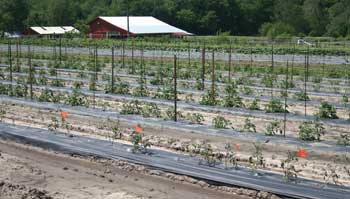
Field trials side by side of grafted and non-grafted tomatoes.

I visited a certified organic commercial farm in central Missouri recently where friends grow for both farmers markets and Whole Foods stores. They are conducting their own trials with grafted tomatoes to see if the claims about production yields are true. They’ve planted 4,000 non-grafted tomatoes, beside 2,000 grafted ones and are keeping detailed records. If the grafted tomatoes live up to their reputation, these folks will move to using all grafted tomatoes next season.
Lonnie and a flat of grafted tomatoes, ready for planting.

What’s this mean for us little gardeners? It means if you like the flavor of heirloom tomatoes but are tired of the virus problems that often come with them, you may want to consider ordering some grafted tomatoes next year. I’ll be reporting more about my own small trials with Territorial Seed grafted tomatoes, along with the trials of the friends who have the 2,000 grafted tomatoes.  Territorial Seed offers a variety of grafted tomato varieties by mail. Happy gardening!

Wednesday, June 1, 2011

Cicadas, What's That Noise?

Cicadas have emerged in about 17 states, including Missouri, Kansas, Illinois, Mississippi and south.

What’s That Noise?

About 10 days ago I was traveling through central Mississippi for a State Master Gardeners Conference. All along the highways as I drove, I could hear the songs of cicadas. I knew ours at home would be emerging in a few days, as the great cicada hatch of 2011 moved northward.

We’re currently in the middle of the emergence of the 13 year cicada or periodic cicada (known as the Magicada). Cicada burrow upward out of the ground and the nymphs climb onto trees, bushes, even tires, where they fasten their claws and the cicadas emerge, leaving behind the old skin.

Cicadas don’t harm trees or shrubbery, and they don’t eat leaves of plants like locust or grasshoppers. The larger portion of the cicada’s 13 year life cycle (or 17, in the instance of the 17 year cicada) is spent underground, feeding on the sap of tree roots. Once they emerge, they are only alive for about 6 weeks to breed, then they die.
All that's left is the "shell" once the cicada has emerged and grown wings.

Cicada “nymphs” once out of the ground and having shed their old skin, climb upward, then fly off. The males are the ones making the noise, trying to attract a mate. Once they have mated, the female flies onto a limb tip of a tree and insert an egg into a tender twig. The egg grows, becoming a small grub which falls to the ground. Once on the ground, it burrows downward to tree roots where it will live and grow for another 13 year cycle. Tender limb tips near the outer edge of trees may fall off, but the pruning is generally helpful, and doesn’t harm the tree.
This one's been out of the ground for a few hours and its wings have matured so it can fly.

There’s no control for these insects, nor is there any need to control them. True, they can be irritating, but even if you sprayed them with insecticide, more would fly in from next door - plus the insecticide would kill off songbirds, cats, dogs and other things that find cicadas to be a delicacy. Be patient, they will be gone in a few short weeks and won’t return for another 13 years.
Cicada killer wasp.

A natural predator of cicadas (besides dogs, cats, birds and humans) is the cicada killer wasp, a flying insect that looks very much like a hornet. Unlike hornets, this wasp lives in a single hole in the ground with just a male and female. While cicada killer wasps can sting if seriously provoked, even then would rather fly away then sting. These wasps are harmless and do a service to homeowners by controlling cicadas.

Cicadas are quite edible and you’ll find plenty of recipes on the internet. We cooked up a batch for supper this week, stir-frying them with garlic, ginger and shallots, then adding Chinese noodles and cilantro. Next I’m going to try the German chocolate cicada cake recipe I found.

Some sources suggest par-boiling the cicadas first (they're also known as "sky prawn" due to the fact that in some regions of the world, they are collected in large nets and meals made from this free protein source).

I fried these in a hot skillet, right after stir-frying some garlic, shallot and ginger. When that was ready, I added some soy sauce - actually Tamari - then added the noodles and some sugar snap peas, with another quick-fry, adding fresh cilantro from the garden just before serving.
Here are some other recipes for you to try.

Chocolate Covered Cicadas
Anything coated in chocolate will be tasty!

8 squares (about 4 oz.)  dark chocolate
30 *dry roasted cicadas

*Roast young cicadas in the oven for 15 minutes at 225F.
Melt chocolate in a double-boiler over low heat. Dip insects in chocolate, place on wax paper let the chocolate harden. Sprinkle with coarse-ground sea salt.

Cicada Wontons

4 oz. package cream cheese, room temperature
30 freshly hot water boiled cicadas (boil for 3 minutes and drain)
1 Tablespoon freshly chopped chives
1 package Wonton wrappers

Drop approximately 1 teaspoon of cream cheese on each of the wonton wrapper, add a pinch of fresh chives, then place 1 cicada on each of the wrapper. Fold in corners and seal with egg white. Fry in hot oil until crispy and brown. Serve with sweet and sour sauce.


For recipes of herbal things that don't involve cicadas, visit my website for my homemade crackers, dips, salsas and other foods, which all include herbs.

Happy Gardening!