Ozarks Gardening
Jim Long
Water to Keep Your Plants Alive
My father had a theory about watering plants. He said that once you start watering plants in a dry season, they come to depend on it, therefore, he wouldn’t start. Of course he was right, once you start watering garden plants, they do start depending on you. But the alternative is to let your plants die, or wait so long to begin watering that they are so completely stressed they won’t recover.
Here are some suggestions for keeping your plants alive. With trees and shrubs you planted this spring (or even last fall), they need a minimum of 10 gallons of water a week, allowed to soak in slowly. It’s better if they have two 10 gallon buckets full a week, soaked in slowly. Don’t make the mistake of soaking them every day, too much water is almost as bad as not enough; the roots will sit there in the wet and not grow at all. If you paid out good money for the tree you planted back in the spring, then weekly watering to keep it alive is a good investment in a shade tree of the future.
With lawns, 3 waterings a week, about 2 hours each time, should keep the grass green. However some varieties of grass will go dormant in dry weather. Bermuda grass, for example, will survive the heat and drought and when it starts raining again, will commence growing again. Bluegrass or similar turf grass lawns, by contrast, need a constant supply of moisture, so it’s best to water those every other day.
Roses and tomatoes both do best if watered in early morning. If you are one of those folks who likes to take the garden hose and spray down your roses or tomatoes late in the afternoon, wetting down the plants and shooting a bit at the roots, then you are doing more harm than good. Both roses and tomato plants are prone to fungal problems, and fungus spores love a hot, wet environment. That method of watering insures you will have blackspot and mildew on your roses because the leaves stay wet overnight. It insures your tomatoes will develop wilt faster, and spread quicker, as well. A much safer and more efficient method is to use a soaker hose in your row of tomatoes and soak them for about an hour, twice each week. Or, use the garden hose without a nozzle, and soak around each tomato plant (or rose bush) for 2 minutes, move on to the next one then come back and do the first one again. Aim only at the root area, don’t soak the leaves. If you must use an overhead sprinkler, use it in the early morning so that the air and sunlight evaporates the moisture from the leaves quickly.
For herbs of most any kind, along with beans and carrots, they are less picky about how they receive water. Overhead sprinklers are fine, soaker hoses work well, too. But with peppers and eggplant, they also do best if watered early in the morning rather than late in the evening. Peppers, eggplants and tomatoes are all distant cousins and while peppers and eggplants don’t suffer from as many fungal problems as tomatoes, keeping their foliage dry when you water the roots is best.
The important thing is don’t use my father’s advice. He would let his garden plants suffer until they couldn’t be revived with water. The better method is to water your plants on a regular basis, not daily because the roots need to go a bit deeper. But 2 or 3 times each week, soak the roots of all your plants well and they will have a very good chance of making it through this persistent drought.
Click the “Follow this blog” button, and you will receive a notice each time a new column appears. Stay cool and keep your plants healthy.
Friday, July 29, 2011


Wednesday, July 20, 2011
Worst Garden Year!
Ozarks Gardening
Jim Long
“Worst Garden Year, Ever”
This week I was in upper Michigan, between Lake Huron and Lake Michigan. The temperatures should be fairly mild there, but instead, were in the mid-90s. Not nearly as bad as the 105 degrees we had in Taney County, MO the day I left, but still hot for those folks.
My reason for being there was to speak at the International Herb Association conference, which draws people from as far away as California, Virginia, Massachusetts, Florida and Texas. The big topic between events and in the evenings, was how difficult a garden year this is. For everyone. I kept hearing, “this is the worst garden year ever!”
Hearing people from across the country telling their garden woes, somehow eased a little of my own discouragement. This is a tough garden year, for everyone.
First, we had too much rain, too little sunshine and longer cool temperatures than are ideal. From the chilly, wet spring we went directly into heat, wind and drought. Plants in the spring didn’t put down deep roots due to the excess moisture. Then when the rains quit, plants suffered from too shallow roots, which in turn, stressed out the leaves and tops.
When plants struggle, like tomatoes, corn, kale and other crops have in these past few weeks, insect pests launch their attack. Insects can sense when a plant is under stress, and they start chewing.
This year we’ve been struggling with squash vine borers for the first time, coupled with cucumber beetles and squash bugs. Fortunately, Japanese beetles are fewer this year in our garden, due in part, I believe, to the Milky Spore Bacteria I’ve been applying spring and fall. It takes awhile for that to have an effect, but it seems to be doing its job.
We’re getting crops of tomatoes, beans, peppers and more, but not in the quantities we’d expect. When temperatures climb over 90 degrees, tomato plants start dropping their flowers instead of setting fruit. We have soaker hoses in most beds, lots of mulch on everything and using all the organic methods we can to keep plants alive and happy, but it’s hard to do anything about the intense heat.
So, if it’s any consolation to your gardening woes this summer, you’re not alone. Lots of us are in the same boat and gardens everywhere are struggling.
Here's what a friend told me he uses for squash vine borers and says it works pretty well:
When you see the hole at the base of the plant where the squash vine borer has entered, stick a crochet hook into the hole and pull out, and kill the borer. Then pile up soil around the wound on the squash stem. The squash will send out roots into the new soil above where the borer was, and the vine will be saved.
He also sprinkles several moth balls around the base of squash plants just as they begin to bloom. Evidently the moth that lays the egg of the borer doesn't like the smell of moth balls and avoids most of the squash!
Happy gardening!
Jim Long
“Worst Garden Year, Ever”
This week I was in upper Michigan, between Lake Huron and Lake Michigan. The temperatures should be fairly mild there, but instead, were in the mid-90s. Not nearly as bad as the 105 degrees we had in Taney County, MO the day I left, but still hot for those folks.
My reason for being there was to speak at the International Herb Association conference, which draws people from as far away as California, Virginia, Massachusetts, Florida and Texas. The big topic between events and in the evenings, was how difficult a garden year this is. For everyone. I kept hearing, “this is the worst garden year ever!”
Hearing people from across the country telling their garden woes, somehow eased a little of my own discouragement. This is a tough garden year, for everyone.
First, we had too much rain, too little sunshine and longer cool temperatures than are ideal. From the chilly, wet spring we went directly into heat, wind and drought. Plants in the spring didn’t put down deep roots due to the excess moisture. Then when the rains quit, plants suffered from too shallow roots, which in turn, stressed out the leaves and tops.
When plants struggle, like tomatoes, corn, kale and other crops have in these past few weeks, insect pests launch their attack. Insects can sense when a plant is under stress, and they start chewing.
This year we’ve been struggling with squash vine borers for the first time, coupled with cucumber beetles and squash bugs. Fortunately, Japanese beetles are fewer this year in our garden, due in part, I believe, to the Milky Spore Bacteria I’ve been applying spring and fall. It takes awhile for that to have an effect, but it seems to be doing its job.
We’re getting crops of tomatoes, beans, peppers and more, but not in the quantities we’d expect. When temperatures climb over 90 degrees, tomato plants start dropping their flowers instead of setting fruit. We have soaker hoses in most beds, lots of mulch on everything and using all the organic methods we can to keep plants alive and happy, but it’s hard to do anything about the intense heat.
So, if it’s any consolation to your gardening woes this summer, you’re not alone. Lots of us are in the same boat and gardens everywhere are struggling.
Here's what a friend told me he uses for squash vine borers and says it works pretty well:
When you see the hole at the base of the plant where the squash vine borer has entered, stick a crochet hook into the hole and pull out, and kill the borer. Then pile up soil around the wound on the squash stem. The squash will send out roots into the new soil above where the borer was, and the vine will be saved.
He also sprinkles several moth balls around the base of squash plants just as they begin to bloom. Evidently the moth that lays the egg of the borer doesn't like the smell of moth balls and avoids most of the squash!
Happy gardening!
Wednesday, June 29, 2011
Grafted Tomatoes
 |
| Tomatoes are grafted when quite small. Notice the grafting clips. |
Grafted Tomatoes
In recent years heirloom tomatoes varieties have made a big comeback. The buying public has grown increasingly weary of store-bought tomatoes which have no flavor. More gardeners have turned to growing heirloom tomatoes, which have outstanding tomato flavor. But many heirloom tomatoes are prone to virus problems (which is one of the reasons tomatoes were hybridized, to avoid some of the disease problems).
 |
| Heirloom tomatoes have the best flavor in taste-tests. |
According to several garden forums and blogs, the top-rated tomato for flavor is the ‘Brandywine,’ followed by ‘Cherokee Purple’ ‘Sun Gold’ and ‘Beefmaster.’ Of course, each gardener has their own tastes and preferences.
Log House Plants in Cottage Grove, OR has been testing grafted tomatoes for several years, attaching such varieties as ‘Big Beef,’ ‘Brandywine’ and ‘Sun Gold’ to the roots of reliably stronger, disease resistant root stock. Their testing has shown an average of 30% increased tomato production, without the disease problems.
In their growing trials, Log House Plants planted grafted and non-grafted tomatoes of the same varieties side by side, in exactly the same growing conditions. The results were dramatic. The grafteds produced larger, healthier plants with more pounds of tomatoes per plant than the non-grafted ones. Additionally, near the end of the season when the non-grafted tomatoes had ceased producing, the grated tomatoes continued producing fruit right up to frost.
 |
| A grafted tomato that is well established, the graft is between my fingers. |
Grafting tomatoes isn’t new, it’s been done commercially in New Zealand and Japan for many years. What is new is growers, like Territorial Seed, are making the grafted tomatoes available to home gardeners. There’s considerable labor involved in the grafting process, making the tomato plants more expensive, but tests have shown the stronger plants and longer production make it a good investment.
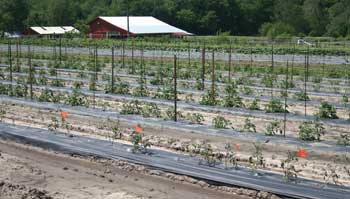 |
| Field trials side by side of grafted and non-grafted tomatoes. |
I visited a certified organic commercial farm in central Missouri recently where friends grow for both farmers markets and Whole Foods stores. They are conducting their own trials with grafted tomatoes to see if the claims about production yields are true. They’ve planted 4,000 non-grafted tomatoes, beside 2,000 grafted ones and are keeping detailed records. If the grafted tomatoes live up to their reputation, these folks will move to using all grafted tomatoes next season.
 |
| Lonnie and a flat of grafted tomatoes, ready for planting. |
What’s this mean for us little gardeners? It means if you like the flavor of heirloom tomatoes but are tired of the virus problems that often come with them, you may want to consider ordering some grafted tomatoes next year. I’ll be reporting more about my own small trials with Territorial Seed grafted tomatoes, along with the trials of the friends who have the 2,000 grafted tomatoes. Territorial Seed offers a variety of grafted tomato varieties by mail. Happy gardening!
Wednesday, June 1, 2011
Cicadas, What's That Noise?
 |
| Cicadas have emerged in about 17 states, including Missouri, Kansas, Illinois, Mississippi and south. |
What’s That Noise?
About 10 days ago I was traveling through central Mississippi for a State Master Gardeners Conference. All along the highways as I drove, I could hear the songs of cicadas. I knew ours at home would be emerging in a few days, as the great cicada hatch of 2011 moved northward.
We’re currently in the middle of the emergence of the 13 year cicada or periodic cicada (known as the Magicada). Cicada burrow upward out of the ground and the nymphs climb onto trees, bushes, even tires, where they fasten their claws and the cicadas emerge, leaving behind the old skin.
Cicadas don’t harm trees or shrubbery, and they don’t eat leaves of plants like locust or grasshoppers. The larger portion of the cicada’s 13 year life cycle (or 17, in the instance of the 17 year cicada) is spent underground, feeding on the sap of tree roots. Once they emerge, they are only alive for about 6 weeks to breed, then they die.
 |
| All that's left is the "shell" once the cicada has emerged and grown wings. |
Cicada “nymphs” once out of the ground and having shed their old skin, climb upward, then fly off. The males are the ones making the noise, trying to attract a mate. Once they have mated, the female flies onto a limb tip of a tree and insert an egg into a tender twig. The egg grows, becoming a small grub which falls to the ground. Once on the ground, it burrows downward to tree roots where it will live and grow for another 13 year cycle. Tender limb tips near the outer edge of trees may fall off, but the pruning is generally helpful, and doesn’t harm the tree.
 |
| This one's been out of the ground for a few hours and its wings have matured so it can fly. |
There’s no control for these insects, nor is there any need to control them. True, they can be irritating, but even if you sprayed them with insecticide, more would fly in from next door - plus the insecticide would kill off songbirds, cats, dogs and other things that find cicadas to be a delicacy. Be patient, they will be gone in a few short weeks and won’t return for another 13 years.
 |
| Cicada killer wasp. |
A natural predator of cicadas (besides dogs, cats, birds and humans) is the cicada killer wasp, a flying insect that looks very much like a hornet. Unlike hornets, this wasp lives in a single hole in the ground with just a male and female. While cicada killer wasps can sting if seriously provoked, even then would rather fly away then sting. These wasps are harmless and do a service to homeowners by controlling cicadas.
Cicadas are quite edible and you’ll find plenty of recipes on the internet. We cooked up a batch for supper this week, stir-frying them with garlic, ginger and shallots, then adding Chinese noodles and cilantro. Next I’m going to try the German chocolate cicada cake recipe I found.
Some sources suggest par-boiling the cicadas first (they're also known as "sky prawn" due to the fact that in some regions of the world, they are collected in large nets and meals made from this free protein source).


Chocolate Covered Cicadas
Anything coated in chocolate will be tasty!
8 squares (about 4 oz.) dark chocolate
30 *dry roasted cicadas
*Roast young cicadas in the oven for 15 minutes at 225F.
Melt chocolate in a double-boiler over low heat. Dip insects in chocolate, place on wax paper let the chocolate harden. Sprinkle with coarse-ground sea salt.
Cicada Wontons
4 oz. package cream cheese, room temperature
30 freshly hot water boiled cicadas (boil for 3 minutes and drain)
1 Tablespoon freshly chopped chives
1 package Wonton wrappers
Drop approximately 1 teaspoon of cream cheese on each of the wonton wrapper, add a pinch of fresh chives, then place 1 cicada on each of the wrapper. Fold in corners and seal with egg white. Fry in hot oil until crispy and brown. Serve with sweet and sour sauce.

For recipes of herbal things that don't involve cicadas, visit my website for my homemade crackers, dips, salsas and other foods, which all include herbs.
Happy Gardening!
Thursday, May 26, 2011
Cool Wet Spring Has Some Advantages
 |
| This has been a great cool season for radishes, onions, incredible salad greens, too! |
Ozarks Gardening, May 21, 2011
Jim Long
Advantages to a Cool, Wet Spring
In the soybean and corn growing areas, farmers report they are unable to get their crops in the ground. Normally by this time, corn and soybeans are about 85% planted. Instead, reports are that only about 25% of those crops are in the ground.
Garden centers, nurseries, even Lowes and Home Depot are reporting their sales are down by about 23% over last year. Home gardeners have been discouraged by the wet spring and lack of sunshine. Everyone’s waiting to buy their tomato plants until they can get their garden tillled and ready.
However the producers at farmers markets are doing a brisk business. Last week I found sweet, ripe, locally-grown strawberries at both Kimberling City, MO and Green Forest, AR markets as well as bountiful lettuce and other produce. These producers have waded mud early in the year to get their plants and seed in the ground. Many say they’ve had to harvest in the rain in order to bring their produce to the markets.
The cool, wet spring has given us, in our garden, probably the best crops of radishes we’ve ever had, and for a longer period of time. (Radishes, as you probably know, turn hot and start going to seed as soon as the temperatures rise). Salad greens, too, have produced exceptionally well in the unusually cool weather. We’ve been harvesting several pounds of mixed salad greens several times a week to take to market.
 |
| Yellow sticky traps attract flea beetles and aphids. Add clove oil and they will attract cucumber beetles, too. |
Insect pests have been less obvious than usual. We had fewer problems with cutworms, possibly because they all drowned. Aphids and flea beetles have arrived on tomatoes but biweekly spraying with Ultra-Fine Oil Spray and yellow sticky traps are keeping the pests at a minimum. Certainly when the weather settles and the sunshine decides to remain, plants will shoot upward like bottle rockets, and the garden pests will arrive, ready for dinner, as well.
It’s not too late to plant many crops. Tomatoes and peppers can still be planted for a slightly later crop, when the weather settles. It is too late to plant peas, potatoes, radishes, cabbage, kale and onions, but most other crops can still go in the ground. Annual flowers, shrubs, trees and perennials, also, will do just fine planted late.

Meanwhile, supplement your weekly meals by shopping at your local farmers market. The producers are having a great year with outstanding lettuce varieties. Sweet, crunchy radishes are in good supply, as is kale, bok choy, green and bulbing onions, shallots, spinach, beets and carrots. New peas and baby potatoes will be arriving this week. Visit the weekly farmers markets in Green Forest, Berryville and Eureka Springs, Arkansas. Weekly markets in Kimberling City, Ava, Mountain View, Ozark, and Springfield, MO are all lively. So is the Saturday Evening Market at Reeds Spring. You’ll find excellent produce each week while you are waiting to get your own garden planted.
 |
| Lots of fresh produce, plants and other goodies. |
This and previous Ozarks Garden columns from this newspaper, with photos and links to more information can be found at: ozarksgardening.blogspot.com. If you would like to see what we’re growing in the garden this year at Long Creek Herb Farm, our annual Open House will be Saturday, June 18, 9:00 a.m. to 3:00 p.m. Call 417-779-5450 for directions and to let us know you’re coming (or email us at Longcreekherbs@yahoo.com. Happy gardening!
Avoiding Tomato Problems
 |
| Yellow sticky traps catch aphids and flea beetles. |
Jim Long
Preparing Tomato Beds
The past couple of springs I’ve written about new research on controlling tomato viruses, from Texas A & M University, and tried their recommended methods. It didn’t control all of the virus problems, thanks to an unusually wet, cool and humid spring we had last season, but I still saw considerable improvements, and will continue with their methods this year.
The methods I use for helping to control tomato virus (often called, “the wilt.”) are as follows. First, I incorporate agricultural cornmeal into the soil early in the year and again just before planting. Whether your local feed store calls it agricultural. cornmeal, or simply ground corn feed, it’s the same thing. Texas A & M has demonstrated that pulverized corn, with some cobs and husks, it’s worked into the soil and causes the growth of beneficial bacteria which attack tomato virus in the soil. I apply 2 lbs. of cornmeal and 1 lb. of dry molasses (which studies show helps the cornmeal work better) per 12 feet of tomato row, poured on top then mixed into the soil.
The second treatment I use, is to mulch the entire tomato bed immediately after the tomatoes are planted. Formerly I’d wait for several weeks to let the ground warm faster, but researchers have proven that putting mulch down immediately, eliminates the splash-up from the soil onto the leaves, and that is how the virus first gets on the lowest tomato leaves. The virus remains in the soil where tomatoes have grown before, and rain splashes the soil, and the virus, on to the lowest leaves of the tomato plants.
Third, I use homemade sticky traps, two for each tomato plant, to trap the aphids that settle in on the tomato plants. It is the aphids that spread the virus (the “wilt), from the bottom leaves upward, by their eating habits. My traps consist of yellow plastic cups, turned upside down and stuck onto 16 inch tall, broomstick-sized sticks, using a thumbtack. The sticks are pushed into the ground about a foot from the tomato plant. I coat the yellow plastic cup on the outside, with Tree Tanglefoot, a very sticky substance that doesn’t wash off. The aphids are attracted to the color yellow and the Tanglefoot catches them.
And last, I begin spraying the plants with Neem oil spray about the second week after planting. Neem prevents the aphids from getting a good start, and kills the eggs and young aphids that can’t yet get to the sticky traps.
To summarize, work the cornmeal into the soil in March, and again in late April; mulch as soon as the plants are in the ground. Then put out yellow sticky traps, 2 for every plant, and within a week of planting, begin spraying the plants with Neem and continue the spraying every 10 days well into summer. This is the best method I’ve found for stopping the wilt and virus problems on tomatoes. (The alternative, which is what old-time tomato growers used, was to plant tomatoes in “new” soil, meaning areas which haven’t had tomatoes growing in them before. That helps cut down on the amount of wilt considerably).
Tree Tanglefoot is available in most garden stores and on-line. Agricultural cornmeal, or its equivalent, pulverized corn feed, is available at most area feed stores. If they don't’ have it, ask them to order it, it’s easily available from their wholesale supplier. Yellow plastic cups were difficult to find last year, so I used yellow, “water wings,” the flexible foam tubes kids use in swimming pools, cutting them up into 4 inch pieces and they worked as well as cups.
To see photos and links to more information, visit the Ozarks Gardening blog at ozarksgardening.blogspot.com. You can see what’s happening in my garden this week at jimlongsgarden.blogspot.com. Our annual open house for the garden is Saturday, June 18. Call for directions: 417-779-5450. Happy gardening!
Saturday, April 23, 2011
Bradford Pear, Not the Best Tree for the Yard
 |
| Bradford Pear is a short-lived tree that has become an invasive plant in some communities. |
Ozarks Gardening
Jim Long
Bradford Pear, Not a Good Choice for the Landscape
The Bradford Pear came about in the 1950s when someone at the Ag. Research Service in Glenn Dale, MD found an especially promising tree grown from seed collected in China. It wasn’t until the 1980s when the Bradford began to be available in nurseries and became the fast-growing fad tree to have in your yard.
 |
| Ailanthus, or Tree of Heaven |
Back in the early 1900s, the fad tree all the magazines were advertising was the Ailanthus, or Tree of Heaven. “Fast-growing, excellent tree for homes,” the ads claimed. There was no mention of the fact that Tree of Heaven is either male or female and if you happened to have a female, the flowers stank to high heaven (which is supposedly where the name came from). We had one on the block where I grew up as a kid, and you could smell the sickly-sweet, cloying flowers all over town. (Read more about the problems this tree is causing across the middle U.S. here).

In the 1950s and ‘60s, it was the Ginkgo biloba tree, with its, “Neat little leaves that look like Chinese fans.” The attraction was the leaves were easy to rake with little mess to clean up and the tree could reach heights of 100 feet or more. Additionally it is a long-lived hard wood tree with specimens reportedly over 2,000 years old and still living, in China. People ordered them from nurseries and magazine ads by the millions, only to learn in a few years that they, too, are either male or female, and the blossoms of the female trees contained butanoic acid and smelled like rancid butter, or worse, when in flower. (You can’t tell the sex of a tree until it’s old enough to bloom, and not all trees are separate sexes, some trees have both male and female flowers on the same tree). Add in the fact the Ginkgo biloba can take 40-60 years to reach its full height, and the tree soon fell out of favor.
The next tree fad to come along was the Hybrid Elm, “An amazingly fast growing, beautiful tree for city boulevards and front lawns” claimed the ads. Unfortunately the Siberian Elm was often substituted, and that’s a very poor tree, Hybrid Elm is slightly better, but still is not the best choice in our region. Lots of us bought them, only to learn later that one good Ozarks ice storm left the trees so completely denuded of limbs that all there was left was a trunk.
But it’s the selling of the Bradford Pear that outshines all previous tree selling fads. The ads in the ‘90s claimed the tree was sterile, producing “little if any fruit” and “no messy pears on the ground in the fall.” They were promoted as the perfect tree for city streets, where the tree stayed in its, “pyramidal shape with glossy green leaves and attractive white flowers in the spring.”
 |
| City streets lined with monotonous Bradford Pear trees. |
Cities bought Bradford pears in mass quantities, as did housing developers, homeowners and industrial parks. This seemed the perfect, fast-growing, no maintenance tree.
Bradford pears were planted in such great numbers they’ve begun to cross and hybridize and unlike the claims of being sterile and never bearing fruit with seed, have shown to reseed themselves and are now considered an invasive species in some areas. Groves of the pests have grown up in ditches and alleyways. Masses of wild Bradford Pear have become a nuisance in some areas where they’re crowding out native species.
The primary flaw in Bradford Pears comes from a combination of fast growth and week wood, coupled with poor branch structure. They generally start breaking apart after only 20 years. The crotch, or where the branch and trunk meet, becomes weak and breaks apart in storms. With their short life span of 20 years or less, weak wood and the boring sameness of white flowers, Bradford Pears have fallen out of favor and we’re ready for the next “perfect” tree to come along.
To see what’s happening in my garden this week: jimlongsgarden.blogspot.com. Happy gardening!
Subscribe to:
Posts (Atom)